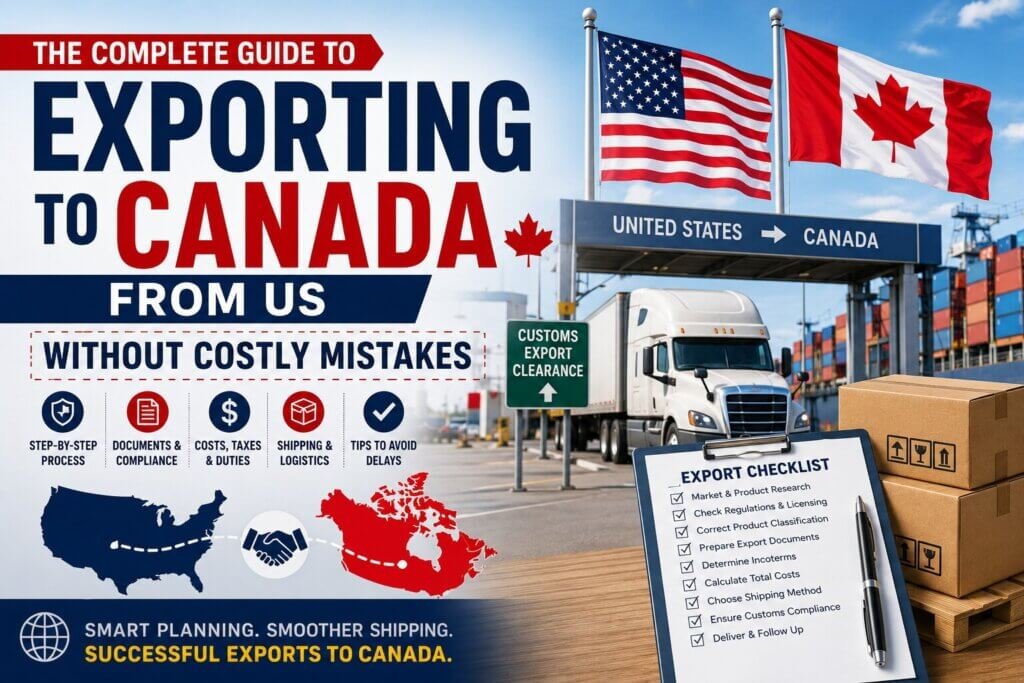
The Complete Guide to Exporting to Canada from US Without Costly Mistakes
Canada is one of the most accessible international markets for American businesses. The two countries share a long border, strong trade relationships, established transportation networks, and a high volume of cross-border commerce.
However, exporting products across the border is not as simple as putting goods on a truck and sending them north.
Businesses involved in exporting to Canada need to understand product requirements, customs documentation, classification, country-of-origin rules, shipping arrangements, taxes, and the responsibilities of both the exporter and importer.
A small mistake can result in delayed shipments, unexpected charges, rejected goods, or unhappy customers.
The good news is that most problems are avoidable.
With the right preparation, exporting to Canada from US can become a structured and repeatable part of your business. This guide explains the key steps, common challenges, and practical considerations that can help you move goods across the border with greater confidence.
Why Canada Is an Important Export Market for US Businesses
Canada has long been one of the most important international trading partners for the United States. Its geographic proximity makes transportation easier than shipping to many overseas markets.
For US businesses, exporting to Canada may offer several advantages:
- Shorter transportation distances
- Established road, rail, air, and freight networks
- Familiar business practices
- Strong demand for many US-made products
- A large and developed consumer market
- Well-established customs procedures
However, proximity should not create a false sense of simplicity.
Canada is a separate country with its own customs rules, product regulations, taxes, labeling requirements, and import procedures.
A shipment that moves easily between two US states may require additional planning when crossing into Canada.
Step 1: Confirm That Your Product Can Be Sold in Canada
The first step in exporting to Canada is understanding whether your product can legally enter and be sold in the Canadian market.
Do not assume that a product approved for sale in the United States automatically meets Canadian requirements.
Depending on the product, you may need to consider:
- Product safety requirements
- Packaging standards
- Labeling rules
- Language requirements
- Certifications
- Testing requirements
- Permits or licenses
- Industry-specific regulations
For example, requirements for food, cosmetics, medical products, chemicals, children’s products, and electronics may differ significantly from requirements for ordinary consumer goods.
Some products may also require bilingual labeling or other information designed specifically for the Canadian market.
Before accepting an order, research the exact product requirements.
Ask two important questions:
Can the product legally enter Canada?
Can the product legally be marketed and sold after it arrives?
Checking these issues before shipping is far easier than dealing with a rejected shipment at the border.
Step 2: Identify Who Will Act as the Importer of Record
One of the most important decisions when exporting to Canada from US is determining who will act as the importer of record.
The importer of record is generally responsible for managing the import process and ensuring that customs requirements are properly handled.
Depending on the transaction, this may be:
- Your Canadian customer
- A Canadian distributor
- Another authorized party
- Your own company, depending on the business structure and arrangement
The responsibilities of the importer can include:
- Providing customs information
- Paying applicable duties and taxes
- Maintaining required records
- Ensuring regulatory compliance
Make sure these responsibilities are clearly understood before the shipment leaves the United States.
Confusion over who is responsible for customs clearance can create delays and unexpected expenses.
Step 3: Determine the Correct Product Classification
Proper classification is an important part of international trade.
Products are generally classified using the Harmonized System, which helps customs authorities determine applicable requirements and duty treatment.
The correct classification may depend on:
- Product materials
- Function
- Composition
- Design
- Intended use
- Manufacturing process
Do not rely solely on a product description from a catalog.
For example, two products that appear similar may have different classifications because they are made from different materials or serve different functions.
Incorrect classification can lead to:
- Customs delays
- Incorrect duty payments
- Additional assessments
- Compliance issues
If the classification is unclear, obtain qualified guidance before shipping.
Step 4: Understand CUSMA and Rules of Origin
The Canada-United States-Mexico Agreement, commonly known as CUSMA, can affect the duty treatment of qualifying goods traded between the United States and Canada.
However, an important distinction must be made:
A product shipped from the United States is not automatically considered US-originating.
For a product to qualify for preferential treatment, it must meet the relevant rules of origin.
This can depend on factors such as:
- Where the product was manufactured
- Where its components originated
- Whether substantial processing occurred
- Product-specific origin rules
For example, a US company may export a product that contains imported components. Whether that product qualifies under CUSMA depends on the applicable rules.
Do not simply assume that goods marked “Made in USA” automatically qualify for preferential treatment in every situation.
Review the relevant origin requirements and maintain documentation that supports your claim.
Step 5: Calculate Your Complete Export Costs
One of the most common mistakes businesses make is focusing only on the cost of producing and shipping the product.
Cross-border trade involves additional expenses.
Your total cost may include:
- Product cost
- Packaging
- Inland transportation
- Freight
- Export documentation
- Customs brokerage fees
- Cargo insurance
- Canadian duties
- Goods and Services Tax or other applicable taxes
- Warehousing
- Final delivery
The exact costs depend on the product and shipping arrangement.
Before setting your price, calculate the full cost of getting the product to the agreed destination.
A Simple Example
Suppose you sell goods worth $20,000.
Your additional costs might include:
- $1,500 for transportation to the border
- $2,000 for freight
- $500 for documentation and brokerage
- $300 for insurance
- $1,200 in other cross-border costs
Your total cost increases significantly beyond the original product value.
If you fail to calculate these expenses before agreeing to a selling price, your expected profit margin can disappear.
Step 6: Choose the Right Incoterm
Incoterms help define the responsibilities of buyers and sellers during international transactions.
Common examples include:
- EXW
- FCA
- CPT
- CIP
- DAP
- DDP
The Incoterm used in your agreement can determine who handles transportation, risk, insurance, customs responsibilities, and other costs.
Before agreeing to an Incoterm, understand:
- Where delivery takes place
- When risk transfers
- Who arranges freight
- Who pays transportation costs
- Who handles export procedures
- Who manages Canadian import clearance
- Who pays applicable duties and taxes
Never select an Incoterm simply because it is commonly used.
Choose one that matches your actual business arrangement and that both parties understand.
Step 7: Prepare Accurate Export Documentation
Good documentation is essential when exporting to Canada.
The documents required depend on the shipment, product, transportation method, and transaction.
Common documents may include:
- Commercial invoice
- Packing list
- Bill of lading
- Air waybill
- Purchase order
- Certificate or certification of origin when applicable
- Export permits, if required
- Product-specific certificates
- Other regulatory documents
The information on these documents should be consistent.
Pay close attention to:
- Product descriptions
- Quantity
- Value
- Weight
- Country of origin
- Buyer and seller information
- Product classification
- Shipping terms
Avoid vague descriptions such as “products” or “samples” when a more specific description is available.
Clear and accurate documentation helps customs authorities understand exactly what is being shipped.
Step 8: Understand US Export Requirements
Many businesses focus heavily on Canadian import requirements and forget that they may also have responsibilities before goods leave the United States.
Depending on the shipment, you may need to consider:
- Export controls
- Licensing requirements
- Restricted parties
- Product restrictions
- Electronic export filing requirements
Certain goods, destinations, customers, or end uses may require additional screening or authorization.
This is particularly important for controlled technology, certain electronics, aerospace products, defense-related items, and other regulated goods.
Before exporting to Canada from US, determine whether your product is subject to any specific US export requirements.
Step 9: Select the Right Transportation Method
The best transportation method depends on your product, shipment size, budget, and delivery requirements.
Truck Freight
Truck transportation is common for cross-border shipments.
It can work well for:
- Palletized cargo
- Regular commercial shipments
- Full truckloads
- Less-than-truckload shipments
Rail Freight
Rail may be useful for large volumes or heavy cargo, particularly when cost efficiency is more important than speed.
Air Freight
Air freight can be useful for:
- Urgent shipments
- High-value goods
- Small packages
- Time-sensitive inventory
Courier Services
Courier services may work well for smaller commercial shipments, samples, and documents.
When comparing options, do not focus only on the freight rate.
Consider:
- Transit time
- Reliability
- Customs handling
- Final delivery
- Insurance
- Handling requirements
The cheapest option may not always provide the best overall value.
Step 10: Make Sure Your Canadian Customer Is Prepared
Even when the US exporter manages most of the shipping process, the Canadian buyer may still have important responsibilities.
Before sending the shipment, confirm:
- The correct delivery address
- Importer information
- Contact details
- Customs broker details, if applicable
- Tax information
- Product requirements
- Who is responsible for duties and taxes
A shipment can be delayed if the importer cannot be contacted or is not prepared to provide the information needed for customs clearance.
Clear communication before shipping can prevent problems at the border.
Step 11: Consider Product Labeling and Packaging Requirements
Product labeling is an area that businesses sometimes overlook.
Canadian requirements may differ from US standards.
Depending on the product, labels may need information related to:
- Product identity
- Ingredients or materials
- Measurements
- Safety warnings
- Country of origin
- Manufacturer information
Some consumer products may also require bilingual information in English and French.
Do not wait until the shipment reaches Canada to discover that the packaging does not meet applicable requirements.
Review labeling requirements during the product-development or packaging stage.
Step 12: Protect the Shipment With Appropriate Insurance
International and cross-border shipments face risks.
These may include:
- Damage
- Theft
- Accidents
- Weather events
- Loss
- Mishandling
Do not assume that a transportation company will automatically reimburse the full value of your goods.
Review the carrier’s liability and consider whether additional cargo insurance is appropriate.
The right insurance decision depends on:
- Shipment value
- Product type
- Transportation method
- Route
- Packaging
- Your ability to absorb a loss
For valuable shipments, insurance can provide important financial protection.
Step 13: Keep Accurate Records
Recordkeeping is an important part of exporting to Canada.
Maintain organized records related to:
- Purchase orders
- Invoices
- Shipping documents
- Classification decisions
- Origin documentation
- Communications
- Permits
- Customs records
Good records make it easier to resolve disputes, answer customs questions, and manage future shipments.
They can also help you identify patterns involving transportation costs, delays, or supplier and customer performance.
Common Mistakes to Avoid When Exporting to Canada
Assuming Canada Works Exactly Like the US
Canada is geographically close, but it has its own customs and regulatory system.
Using Vague Product Descriptions
Clear descriptions reduce confusion and make customs processing easier.
Ignoring Product-Specific Regulations
Check requirements before shipping, especially for regulated products.
Assuming Every US Shipment Qualifies Under CUSMA
Origin rules determine whether a product qualifies for preferential treatment.
Choosing the Wrong Incoterm
Make sure both parties understand their responsibilities.
Ignoring Taxes and Additional Costs
Calculate the complete transaction cost before setting your price.
Failing to Prepare the Canadian Importer
The shipment can be delayed if the importer is not ready to complete customs procedures.
Using Incorrect Product Classification
Classification can affect duties, reporting, and regulatory requirements.
A Practical Checklist Before Your First Shipment
Before exporting to Canada from US, review the following:
Product
- Have you confirmed that the product can enter Canada?
- Does it meet applicable Canadian standards?
- Are labeling requirements satisfied?
Customs
- Is the product properly classified?
- Have you reviewed applicable origin rules?
- Do you know who will act as the importer of record?
Costs
- Have you calculated transportation and documentation expenses?
- Have you considered applicable duties and taxes?
- Have you included insurance and final delivery?
Documentation
- Is the commercial invoice accurate?
- Is the product description specific?
- Are the values and quantities correct?
Logistics
- Have you selected the right transportation method?
- Do you understand the Incoterm?
- Is the Canadian customer prepared for delivery and customs clearance?
Final Thoughts
Exporting to Canada can be an excellent opportunity for US businesses, but successful cross-border trade requires preparation.
The strongest approach is to understand the entire process before your goods leave the United States.
Confirm that your product meets Canadian requirements. Use the correct classification. Understand applicable origin rules. Calculate all transportation and cross-border costs. Prepare accurate documentation and clearly define the responsibilities of the exporter and importer.
Most costly mistakes happen because businesses assume that trading with Canada is exactly the same as domestic shipping.
It is not.
However, it also does not need to be overly complicated.
With clear planning and accurate information, exporting to Canada can become a manageable and repeatable process.
The key is to prepare before shipping rather than trying to solve problems after your goods reach the border. By understanding the requirements involved in exporting to Canada from US, businesses can reduce delays, control costs, and build stronger cross-border operations.
Frequently Asked Questions
Do US businesses need a license for exporting to Canada?
Not every product requires an export license. However, certain products may be subject to US export controls, licensing requirements, or other restrictions.
Does every product exported from the US qualify for duty benefits under CUSMA?
No. The product must meet the applicable rules of origin to qualify for preferential treatment.
Who pays duties and taxes when exporting to Canada?
This depends on the transaction and agreed Incoterm. The Canadian importer is often responsible for import duties and taxes, but responsibilities can vary.
What documents are commonly needed when exporting to Canada?
Common documents include a commercial invoice, packing list, transportation documents, origin documentation when applicable, and product-specific permits or certificates.
What is the biggest mistake when exporting to Canada from US?
One of the biggest mistakes is treating the shipment like a domestic delivery. Businesses should understand customs, regulatory requirements, product classification, taxes, documentation, and shipping responsibilities before sending the goods.

In today’s fast-moving retail world, packaging has become more than just a wrap. It helps you connect directly with customers. Read more

Cats are curious, comfort-loving creatures. They love cozy spaces, hidden nooks, and interactive play — which is exactly why cat Read more

If you’ve recently searched for the perfect lounging space for your feline friend, you’ve probably come across two popular terms: Read more

Introduction: The Rise of Luxury Streetwear Over the past decade, streetwear has transformed from a niche subculture into a global Read more