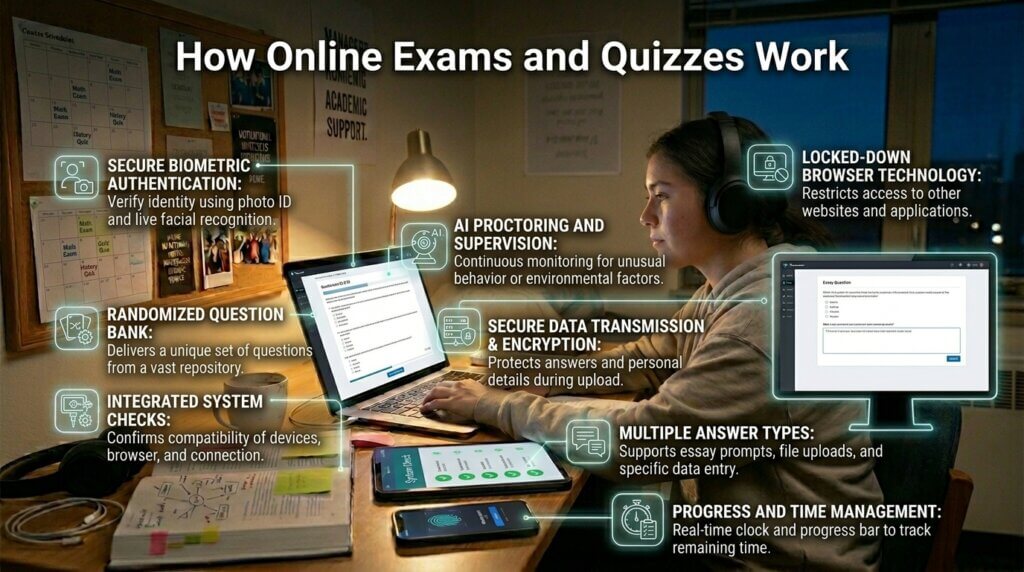
How Online Exams and Quizzes Work
Online education has changed not only how students attend classes but also how they are assessed. Many learners feel uncertain about virtual testing because it differs from traditional in-person exams. Understanding How Online Exams and Quizzes Work can reduce anxiety and help students prepare effectively.
This article explains the structure of online assessments, the role of proctoring systems, timed assessments, security measures, and how online testing platforms operate. It also provides practical preparation strategies so students can approach virtual exams with confidence.
Understanding the Structure of Online Assessments
Online exams and quizzes are designed to measure learning outcomes while maintaining fairness and academic integrity. Although formats may vary between institutions, most digital assessments follow predictable patterns.
Question Types Used in Virtual Exams
Online exams typically include multiple-choice questions, short answers, essays, and sometimes interactive problem-solving tasks. The format depends on the subject and the instructor’s goals.
Unlike paper tests, digital exams may randomize questions to ensure fairness.
Access Windows and Availability
Many assessments are available within a specific timeframe rather than a single fixed hour. Students may have a 24-hour window to begin, but once started, the clock runs continuously.
This structure supports flexibility while still maintaining structure.
Immediate or Delayed Results
Some quizzes provide instant feedback, especially objective questions. Others require manual grading by instructors, leading to delayed results.
Understanding these processes helps clarify expectations and reduce uncertainty.
Online Testing Platforms Explained
Behind every online exam is a digital system that delivers questions, records responses, and manages timing. These platforms are designed to ensure smooth operation and academic security.
Learning Management Systems (LMS)
Most institutions use LMS platforms such as Blackboard, Canvas, or Moodle to host exams. These systems organize course materials and assessments in one centralized dashboard.
Knowing how online testing platforms explained operate helps students navigate them more efficiently.
Built-In Security Features
Platforms often include automatic submission when time expires, randomized question pools, and limited backtracking options.
These features prevent unfair advantages and maintain consistency.
Technical Requirements for Students
Students typically need a stable internet connection, updated browsers, and sometimes additional software for monitoring purposes.
Testing equipment in advance reduces technical stress on exam day.
Proctored Online Tests and Academic Integrity
To maintain credibility, many institutions use proctoring tools during high-stakes exams. These systems monitor student activity to ensure fairness.
Live Proctoring With Human Monitors
In some cases, a remote proctor observes students via webcam during the test. The proctor verifies identity and ensures exam rules are followed.
These proctored online tests mimic traditional supervised environments.
Automated Proctoring Software
Other exams use AI-based systems that track eye movement, background noise, or unusual behavior. Alerts are generated if irregularities are detected.
This method strengthens efforts toward preventing cheating in online exams.
Identity Verification Measures
Students may be required to present identification or complete biometric verification before starting the test.
Such measures protect the integrity of academic credentials.
Timed Assessments in E-Learning
Time limits are a central feature of many virtual exams. Understanding how they function allows students to plan effectively.
Countdown Timers and Automatic Submission
Once an exam begins, a visible timer tracks remaining time. When the timer ends, the system automatically submits answers.
These timed assessments in e-learning require careful pacing.
Restrictions on Pausing or Leaving the Exam
Some platforms lock the test window, preventing navigation away from the page. Exiting may end the session or trigger security flags.
Knowing these restrictions prevents accidental disruptions.
Strategies for Managing Time Effectively
Students should allocate time based on question weight and difficulty. Reviewing instructions before starting ensures a clear plan.
Preparation reduces panic under timed conditions.
Preventing Cheating in Online Exams
Maintaining fairness in digital testing is a priority for educational institutions. Security measures protect both students and academic standards.
Question Randomization
Exams may pull questions from large databases, ensuring no two students receive identical versions.
Randomization supports integrity without compromising assessment quality.
Browser Lockdown Systems
Some tests require special software that restricts access to other websites or applications during the exam.
These tools help prevent external assistance.
Data Analysis After Submission
Institutions may analyze answer patterns for irregular similarities among students.
These safeguards reinforce fairness while maintaining trust in online education.
Virtual Exam Preparation Tips for Success
Understanding exam mechanics is only part of the equation. Effective preparation ensures confidence and performance.
Test Technology in Advance
Run system checks before the exam to verify compatibility with required software.
This step prevents avoidable technical interruptions.
Practice With Sample Questions
Familiarity with question formats improves speed and accuracy during actual assessments.
These virtual exam preparation tips build confidence and reduce surprises.
Create a Distraction-Free Environment
Choose a quiet location, ensure proper lighting, and eliminate background noise.
Preparation of the physical space supports focus and performance.
Managing Anxiety Around Online Exams
Many students feel heightened stress during virtual testing due to unfamiliar procedures or technical concerns.
Review Exam Guidelines Carefully
Understanding rules about materials, timing, and proctoring eliminates confusion.
Clarity reduces unnecessary anxiety.
Maintain Healthy Study Habits
Consistent revision and balanced sleep improve cognitive performance.
Preparation strengthens confidence on exam day.
Stay Calm During Technical Issues
If problems occur, contact support immediately and follow institutional guidelines.
Remaining composed ensures smoother resolution.
Conclusion
Understanding How Online Exams and Quizzes Work empowers students to approach digital assessments with clarity and confidence. From proctored online tests and timed assessments in e-learning to platform security and preparation strategies, each component plays a role in maintaining fairness and academic standards.
For students who feel overwhelmed during intensive exam periods, some choose to get help with online exams and coursework through services like paysomeonetodomyonlinecourse.com, especially when balancing multiple commitments. Used responsibly, additional support can help manage academic pressure while maintaining steady progress.
FAQ’s
1. Are online exams harder than traditional classroom tests?
Online exams are not necessarily harder, but they require familiarity with digital platforms and time management. Students must prepare for technical requirements in addition to subject knowledge.
2. What happens if my internet disconnects during a proctored online test?
Most institutions have procedures for technical disruptions. Students should immediately contact their instructor or technical support and provide documentation if required.
3. How can I prepare for timed assessments in e-learning?
Practice answering questions within specific time limits and simulate exam conditions. Time awareness improves pacing and reduces stress during the actual assessment.
4. How do schools prevent cheating in online exams?
Schools use proctoring software, identity verification, question randomization, and browser lockdown tools. These systems maintain academic integrity while supporting remote education.
5. Can I take online exams from anywhere?
Generally, yes, as long as you meet technical requirements and have a quiet environment. Some proctored exams may require specific conditions, such as a private room and stable internet connection.
Waiting for exam results can be stressful, especially for a key medical qualification. The waiting period can feel long, as Read more

Want to learn how to sell things online? Want a job that lets you work on your phone or laptop? Read more

Let's be real, folks. Certification exams, especially something like the CompTIA SY0-701, can feel like an absolute monster. When I Read more

Preparing students for a global future is important. This article will highlight how International Schools in Manila are specifically designed Read more