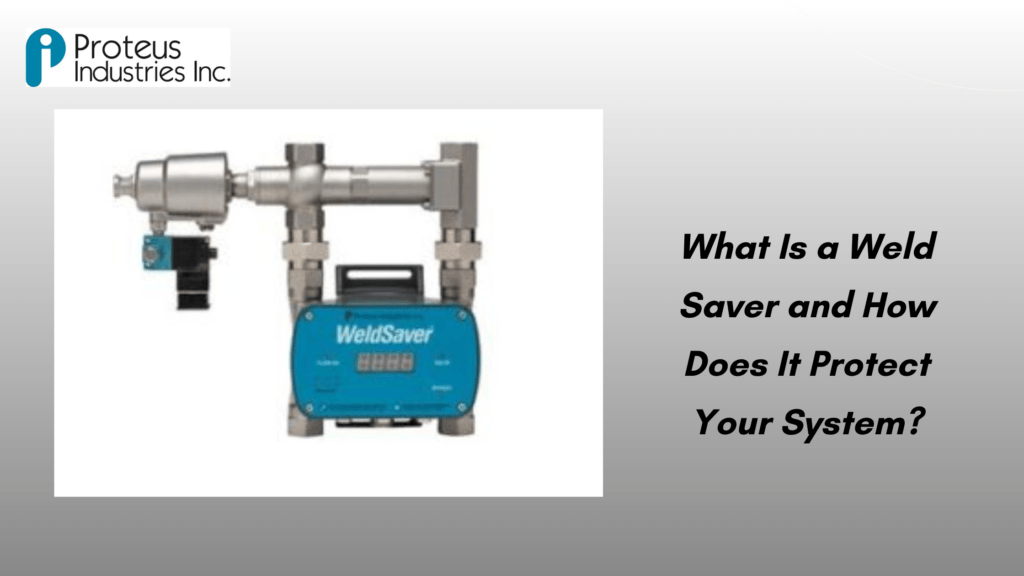
What Is a Weld Saver and How Does It Protect Your System?
Your production line is running smoothly. Welds are being made. Parts are moving through the system exactly as they should. Everything looks normal from the outside.
But inside your welding system something is quietly going wrong. The cooling water flow has dropped. Not dramatically — just enough to start allowing heat to build up in places it should not be. In the electrodes. In the cables. In the transformer.
And because there is nothing in place to catch it — nothing monitoring that critical cooling flow — the heat keeps building. Slowly but relentlessly. Until something fails.
An electrode warps. A cable overheats. A transformer gets damaged. The production line stops. And the cost — in equipment damage, in replacement parts, in lost production time — is significant.
Now picture the same scenario — but this time your system has a weld saver installed.
The moment that cooling flow drops below the safe threshold the weld saver detects it immediately. It sends a signal to the welding controller. The weld cycle stops. No more heat builds up. No damage occurs. The problem gets identified and fixed. And production resumes without any of the costly consequences that would have followed.
That is what a weld saver does. And that is why your system needs one.
What Exactly Is a Weld Saver?
A weld saver — sometimes called a weld coolant monitor or cooling water monitor — is a specialized flow monitoring device designed to protect resistance welding equipment by continuously monitoring the flow of cooling water through the welding system.
To understand why this matters you need to understand what happens during resistance welding.
Resistance welding — the process of joining metal components by passing electrical current through them — generates enormous amounts of heat at the weld point. That heat is intentional and necessary for the welding process. But it also needs to be managed carefully — because if it builds up in the wrong places it causes serious damage to the welding equipment.
The solution is cooling water. A continuous flow of water circulates through the welding electrodes, cables, and transformer — absorbing the heat generated during each weld cycle and carrying it safely away from the equipment.
This cooling water flow is not optional. It is not a backup system. It is an absolutely essential part of every resistance welding operation — and the moment it fails or drops below a safe level the equipment is at risk.
A weld saver monitors that flow continuously — and intervenes the instant something goes wrong.
How Does a Weld Saver Work?
The operating principle of a weld saver is beautifully straightforward — which is a large part of what makes it so reliable.
The device is installed directly in the cooling water circuit of the welding system. It uses precision flow sensing technology to monitor the water flow continuously — every second the system is operating.
The weld saver knows what normal looks like. It has been set with a minimum flow threshold — the lowest acceptable flow rate that keeps the welding equipment operating safely within its thermal limits.
The moment the actual flow drops below that threshold — for any reason — the weld saver responds immediately.
It sends an output signal to the welding controller instructing it to stop the weld cycle. No more welds are made until the cooling flow is restored to a safe level.
The whole process happens in milliseconds. Before the insufficient cooling has any chance to cause heat damage to the electrodes, cables, or transformer the weld saver has already intervened and protected the equipment.
Once the cooling flow issue is identified and resolved — whether it was a blocked line, a failed pump, a kinked hose, or any other cause — the system can resume normal operation.
What Can Cause Cooling Flow Problems?
Understanding what causes cooling flow issues helps you appreciate just how important continuous monitoring really is.
Blocked or Kinked Hoses — Cooling water hoses can become kinked, pinched, or partially blocked over time. The flow restriction might be gradual — not dramatic enough to notice without monitoring — but significant enough to allow heat to build up over time.
Pump Failures — The pump driving your cooling water circulation can fail partially or completely. A partial failure might reduce flow to dangerous levels without stopping it entirely — making it invisible without a monitoring device.
Scale and Mineral Buildup — In hard water areas mineral deposits can gradually build up inside cooling lines, restricting flow over time. This is a slow process that is almost impossible to detect without continuous monitoring.
Leaks — A leak in the cooling circuit reduces the flow available to the equipment. Depending on where the leak occurs it might not be immediately visible — but the reduced flow creates real risk for the welding equipment.
Valve Issues — Partially closed or malfunctioning valves can restrict cooling flow without completely stopping it. Again — invisible without monitoring but genuinely dangerous.
Every one of these scenarios is caught immediately by a weld saver. Without one they go undetected until the damage is done.
What Happens Without a Weld Saver?
Let us be completely clear about the consequences of operating a resistance welding system without cooling flow protection.
Electrode Damage
Welding electrodes are precision components designed to operate within a specific temperature range. Adequate cooling is what keeps them there. Without it electrodes overheat, deform, and degrade rapidly — resulting in poor weld quality, inconsistent results, and frequent expensive replacements.
Cable Overheating
Welding cables carry the enormous electrical current required for resistance welding. They are also carrying heat — and they depend on cooling water to manage that heat safely. Sustained overheating breaks down cable insulation, causes internal damage, and eventually leads to cable failure.
Transformer Damage
The welding transformer is one of the most expensive components in the entire system. It is also one of the most vulnerable to thermal damage when cooling flow is inadequate. Repairing or replacing a damaged transformer is a significant cost — and the downtime involved while it happens is even more expensive.
Production Downtime
When welding equipment fails due to thermal damage caused by inadequate cooling the production line stops. In automotive manufacturing, metal fabrication, appliance production, and other high-volume industries every minute of unplanned downtime has a direct and measurable financial cost.
Safety Hazards
Overheated welding equipment creates genuine safety risks — electrical faults, fire hazards, and other dangerous conditions that put workers and facilities at risk.
Every one of these consequences is completely preventable with a weld saver.
The Key Features of a Quality Weld Saver
When choosing a weld saver for your system here are the features that matter most.
Accurate and Reliable Flow Sensing — The foundation of effective protection. Your weld saver needs to detect real flow changes accurately and consistently — without false alarms or missed events.
Fast Response Time — Protection only works if it happens fast enough to prevent damage. Look for a weld saver with a response time measured in milliseconds.
Adjustable Flow Setpoints — Different welding applications have different cooling requirements. A quality weld saver lets you set the threshold that is right for your specific equipment.
Clean Output Signal — The signal to your welding controller needs to be clean, reliable, and compatible with your existing control system.
Durable Industrial Construction — Your weld saver lives in a demanding industrial environment. It needs to be built to handle heat, vibration, and continuous operation reliably over the long term.
Simple Installation — The best weld savers are straightforward to install and configure — getting your protection in place quickly without excessive complexity.
Industries That Depend on Weld Savers
Weld savers are essential across every industry that uses resistance welding.
Automotive Manufacturing — One of the largest users of resistance welding in the world. High-volume production lines making thousands of welds per day absolutely depend on reliable cooling protection.
Metal Fabrication — Fabrication shops using spot welding, seam welding, or projection welding need consistent cooling to maintain consistent weld quality.
Appliance Manufacturing — Consumer appliance production relies heavily on resistance welding — and on the cooling systems that keep that equipment performing reliably.
Aerospace — Precision welding in aerospace demands absolute consistency. Cooling failures are simply not acceptable where component integrity is critical.
Electronics Manufacturing — Precision resistance welding in electronics production requires the tight process control that reliable cooling monitoring provides.
Protect Your System With Proteus Industries
At Proteus Industries we have been designing and manufacturing precision flow monitoring solutions — including industry-leading weld savers — for decades.
We understand what real industrial welding environments demand. We know what it takes to build a weld saver that performs reliably day after day in the most challenging conditions. And we are committed to delivering solutions that protect your equipment, your production, and your people.
Ready to protect your welding system with a weld saver that truly delivers? Contact Proteus Industries today — and let our experts help you find the right solution for your specific application.
Because your welding equipment is too valuable to run without protection.
Proteus Industries — Weld Saver Protection Built for Real Industrial Demands.