
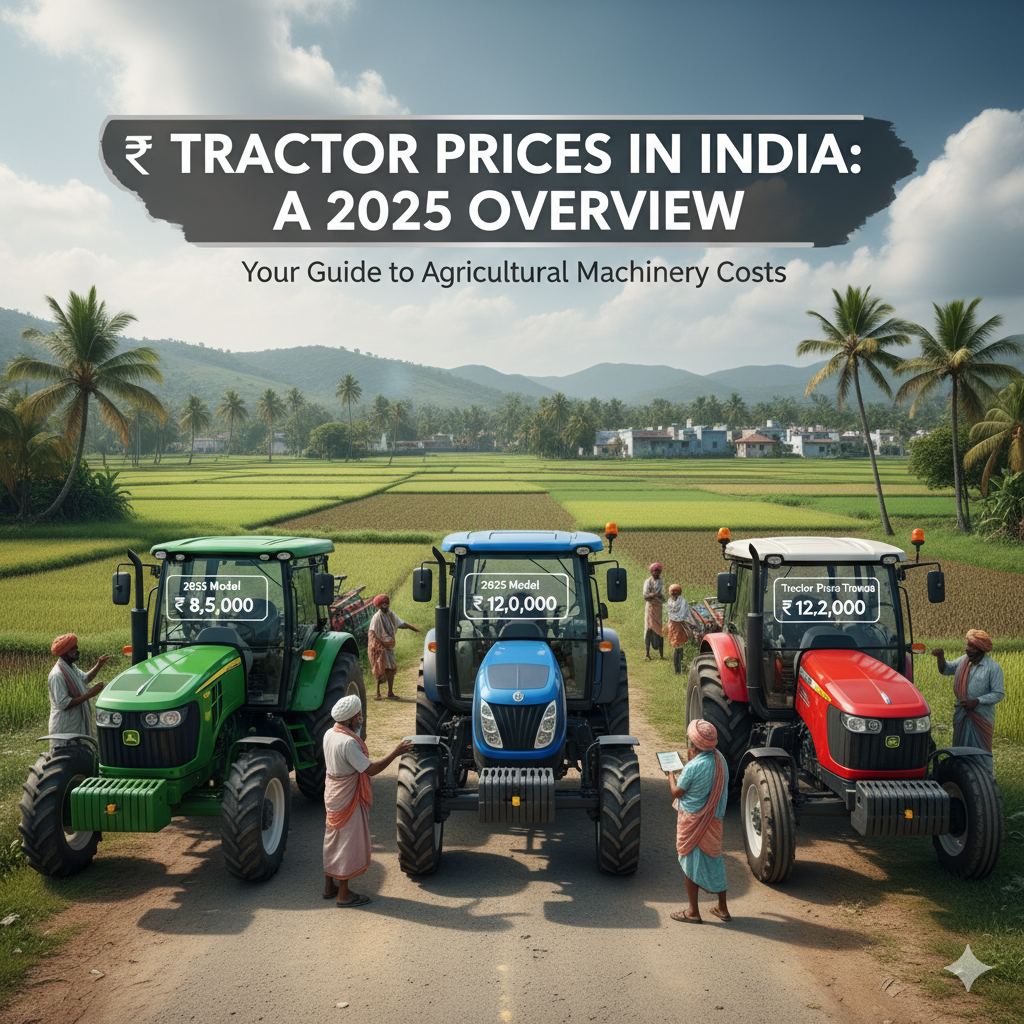
India’s agriculture sector is ever-evolving, and tractors remain a lifeline for millions of farmers—whether for plowing fields, hauling produce, or managing orchards. In 2025, tractor prices vary widely, catering to all needs from compact mini-tractors to high-power 4WD machines. Here’s a detailed breakdown of the current landscape.
Tractor Prices by Horsepower (HP)
| HP Category | Ideal For | Starting Price (₹) |
|---|---|---|
| 20–30 HP | Small farms/orchards | ₹2.6 – 4.2 lakh |
| 31–40 HP | Medium-sized fields | ~₹4.8 lakh |
| 41–50 HP | Main farm work | ~₹6.7–7.4 lakh |
| 51–60 HP & above | Commercial/heavy-duty tasks | ₹8 lakh and above |
Popular Models and Their Price Highlights
Mahindra
-
Jivo Series (Mini Tractors)
Affordable and efficient—ideal for tight fields and orchards: starting from ₹4.6 lakh for models like JIVO 225 DI
-
Yuvo Series
Blends modern features with comfort—starts around ₹5.3 lakh to ₹9.3 lakh depending on HP
-
XP Plus Series
Mid-range, performance-focused models such as:
- 575 DI XP Plus: ₹7.38–7.78 lakh (47 HP)
- 475 DI XP Plus: ₹6.7–7.3 lakh (44 HP)
- 265 DI XP Plus: ₹5.76 lakh (33 HP)
-
Novo/Arjun Series (Heavy‑Duty)
Durable tractors aimed at large-scale operations:
- Starting from ₹9.6 lakh; models like Arjun Novo 605 DI–i around ₹9.8 lakh and up to ₹13.5 lakh
Swaraj
- Known for simple design and affordability:
- Swaraj 735 FE: from ₹5.85 lakh
- Swaraj 744 FE: ~₹6.90 lakh
- Swaraj 744 XT: ~₹7.3 lakh
- Swaraj 855 FE (2WD): ~₹7.7 lakh
- Swaraj 963 FE (Premium): ~₹9.8 lakh
John Deere
- D Series (Value & versatility): Starts around ₹6.52 lakh. Models like 5050D (50 HP), 5105 (40 HP), and 5045D are favourites for durability and fuel economy
- Mini Tractors: Compact 28–36 HP models from around ₹7.53 lakh
- E Series & Premium: Advanced tech and higher comfort—starting at ₹8.3 lakh. High-HP models like the 5130 M (130 HP) may go beyond ₹15 lakh
Other Brands
- Sonalika DI 60 Sikander DLX TP: 60 HP, from ₹8.4 lakh
- New Holland 3630 TX Super: 50 HP, from ₹8.20 lakh
- New Holland Excel 5510: ~₹10.9 lakh
- ACE Forma DI 450 (25.7 HP): ~₹5.19 lakh
Financing, Subsidies & True Cost-to-Farmer
- Subsidies: Farmers may benefit from discounts ranging between 20–50%, plus PM Kisan Tractor Yojana assistance of up to ₹1.5 lakh for first-time buyers
- EMI Options: Finance from institutions like Mahindra Finance, SBI, HDFC offers flexible plans—EMIs starting from ₹7,000–8,500/month depending on the tractor and tenure
- On-road vs. Ex-showroom: Always account for RTO charges, insurance, and accessories; on-road price can significantly exceed ex-showroom rates
Choosing the Right Tractor: Quick Tips
- Assess your land size & crop needs: Mini tractors suit small patches, while 50 HP+ models shine on larger farms.
- Match HP with workload: Overpowering leads to overspending; underpowering hampers productivity.
- Check service network: Mahindra and Swaraj excel in rural service coverage.
- Look for subsidies/EMI schemes: They’re often the smartest cost-saving tools.
- Prioritize resale value: Established brands like John Deere and Swaraj tend to hold value better.
Regional Variations in Tractor Prices
Tractor prices in India can also vary depending on the region. Factors like state-specific subsidies, dealer networks, transportation costs, and local taxes contribute to these variations. For example, prices in Punjab and Haryana may differ from those in Maharashtra or Tamil Nadu due to differing levels of mechanization and demand. Additionally, regions with stronger dealership presence often offer better after-sales service and seasonal discounts, influencing overall cost-to-farmer. It’s always recommended to compare on-road prices from multiple dealers in your area before making a purchase to ensure the best value.
How to Get the Best Deal on Tractor Prices in India
Buying a tractor is a long-term investment, and understanding how to get the best value is essential. With tractor prices in India ranging from ₹2.5 lakh to over ₹15 lakh, it’s important to align your budget with your agricultural needs. Start by comparing multiple brands and models within your desired horsepower range. Brands like Mahindra, Swaraj, and Sonalika often offer seasonal discounts, especially around the Rabi and Kharif seasons.
Don’t forget to explore government subsidy schemes such as the PM Kisan Tractor Yojana or state-level incentives, which can reduce the purchase cost by 20% to 50% for eligible farmers. Financing is another key consideration—many banks and NBFCs provide tractor loans at low interest rates with minimal paperwork. Always calculate the total cost of ownership, including fuel consumption, maintenance, insurance, and resale value.
Visiting local dealers for test drives and negotiating add-ons like implements or extended warranties can further enhance the deal. Also, consider checking tractor expos or agricultural fairs where manufacturers offer exclusive deals. By staying informed and exploring all available options, farmers can secure the best tractor prices and maximize returns on their investment.
Second-Hand Tractor Market in India
For many small and marginal farmers, purchasing a brand-new tractor may not be financially feasible. This is where the second-hand tractor market plays a crucial role. The demand for used tractors is growing rapidly across India, especially in rural and semi-urban regions. One of the main advantages is affordability—tractor prices in the second-hand market can be 30% to 50% lower than new models, depending on the brand, model, age, and condition.
Brands like Mahindra, Swaraj, and Eicher tend to retain good resale value, making them popular choices in the pre-owned market. Many certified dealers and online platforms now offer refurbished tractors with warranties, service support, and financing options, giving buyers more confidence. However, buyers should always inspect the tractor thoroughly for engine performance, tyre condition, service history, and legal ownership before making a deal.
Additionally, farmers should verify RTO documents and check for any outstanding loans or legal issues associated with the vehicle. With proper due diligence, second-hand tractors can provide excellent value and performance at a fraction of the cost, especially for those looking to upgrade from manual labor or bullock carts. The expanding used tractor market is making farm mechanization more accessible across India.