
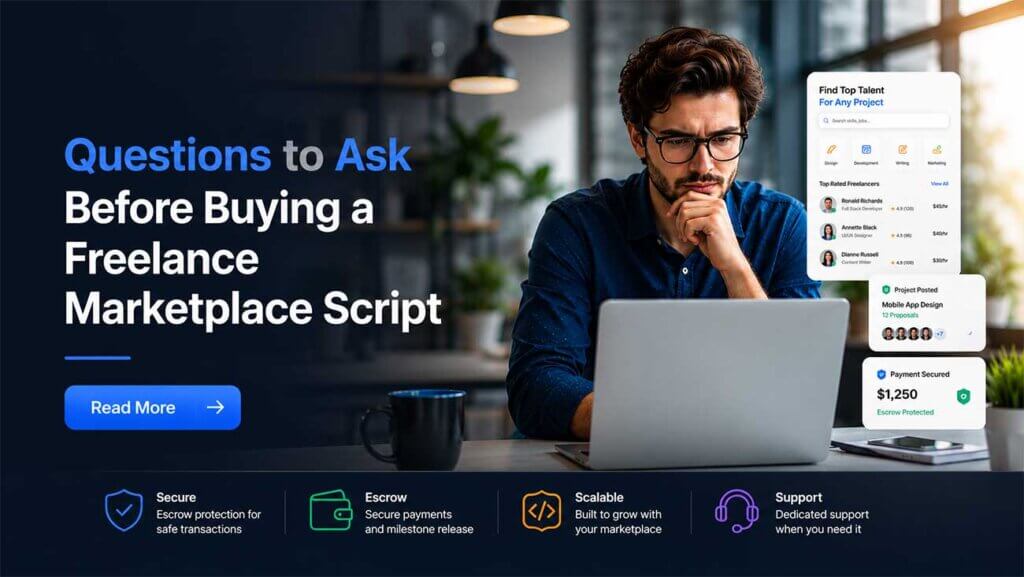
A founder wires $1,500 for a freelance marketplace script on a Tuesday. By Friday, they’re asking support why the source code folder is locked. This happens more often than the sales pages let on.
The freelance platforms market is expected to grow from $7.3 billion in 2026 to $24.2 billion by 2033, according to a Grand View Research report. That growth has pulled dozens of vendors into the space, and not all of them sell the same thing under the same name.
A freelance marketplace script is prebuilt software that lets you launch a two-sided platform without writing the core system from scratch. Some hand over full ownership. Others keep you dependent on the vendor for every update. The questions below separate the two.
Why Choosing the Right Freelance Marketplace Script Matters
A marketplace script isn’t a website template. It’s the operational backbone of a two-sided business, handling job postings, bidding, payments, and disputes at once. Get it wrong, and you’re not fixing a design flaw. You’re rebuilding your business.
Founders often shop for one the way they’d shop for a landing page builder: price first, everything else later. That works for a blog, not a platform holding other people’s money, and the wrong choice surfaces right when you finally have paying users.
Does the Script Include Full Source Code Ownership?
This is the most consequential question, and the one most founders skip. Some vendors sell a license to use the software; others sell the actual code, yours to keep and host anywhere. Ask directly: if the vendor disappeared tomorrow, would your platform keep running? If the answer involves their servers or approval, you don’t own it. You’re renting with extra steps.
This also shapes the SaaS-versus-self-hosted decision founders eventually face anyway. Full ownership gives you that choice later; a locked license makes it for you, permanently. Get the terms in writing before payment, since verbal reassurances won’t hold up eighteen months from now.
Can the Software Be Fully Customized for Your Business?
Every vendor claims their script is “fully customizable.” Few define what that covers. Push past the word and ask about three layers: branding, backend workflow logic, and database structure.
Changing colors and a logo is cosmetic. Real customization means adding a niche-specific field to job postings or changing how commissions split across milestones. If a vendor can’t answer with a plain yes or no, that’s information too, and vague answers on a sales call often turn into change-request invoices weeks after launch.
Does It Support Escrow Payments and Secure Transactions?
Escrow is what makes a freelance marketplace different from a job board. It holds a client’s payment until agreed work is delivered, which is the main reason people trust a platform enough to transact through it. The setup should support milestone-based releases, not just a lump-sum hold: a logo project might have a concept round and a final round, and the escrow logic needs to match that.
Per a breakdown of white-label marketplace features, escrow and smart-contract-style release conditions are now baseline infrastructure, not an add-on. Confirm which payment processor it runs on and whether it operates in the countries your users live in.
Are Android and iOS Mobile Apps Included?
Freelancers check job alerts between other jobs, often from a phone. A script that ships web-only puts you at a disadvantage against competitors who let users bid, chat, and get paid from an app. Ask three things: are the apps included in the base price, are they native or hybrid, and who owns the App Store and Play Store listings. Some vendors keep publisher access under their own account, a problem the day you want to update the app yourself.
What Essential Features Should a Freelance Marketplace Script Have?
A solid freelance marketplace script covers a specific, non-negotiable feature set. Anything missing should be treated as a gap, not a “coming soon.”
- Job posting and bidding, or a fixed-price gig catalog
- Freelancer profiles with portfolio uploads and verified skill tags
- Milestone-based escrow payments with dispute resolution
- Ratings and reviews visible on both sides of a transaction
- Real-time messaging between clients and freelancers
- Admin dashboard for commission control and reporting
- Search and filtering by skill, budget, and rating
For how these pieces fit together, this walkthrough of what a ready-made Upwork-style platform typically includes is worth a look before comparing vendors.
Is the Platform Scalable for Future Growth?
A script that works for 200 users can buckle at 20,000. Ask about database architecture and whether the vendor has taken a client platform through a real growth curve, not just a demo.
Demand for AI-tagged freelance skills grew 109% year over year on major platforms, per gig economy data for 2026, and analysis of where AI is reshaping matching and search suggests smart-matching is moving from nice-to-have to expected. A rigid architecture won’t absorb that shift easily. Scalability isn’t only about traffic; it’s whether the platform can grow features without a rebuild.
What Technical Support, Updates, and Licensing Are Included?
This is where the real cost of a “cheap” script surfaces. Licensing terms vary: one-time purchase, annual renewal, or a support subscription bolted on after the sale. Read the fine print before the invoice.
Some vendors bundle this into the license instead of charging separately. Best Freelancer Script, for instance, ships as a self-hosted PHP-based package with update access included in the base purchase, which matters for founders who don’t want a recurring support bill on top of the license fee. Others handle support as a paid add-on, billed per ticket, which adds up before your team knows the codebase well. Ask how updates are delivered, too: automatic patches are convenient but can overwrite custom code, while manual updates give control but leave fixes to whoever remembers to apply them.
How Much Does a Freelance Marketplace Script Really Cost?
Prices swing hard. Bare-bones scripts start under $2,000, while custom development for the same feature set runs $40,000 to $150,000 or more, according to cost breakdowns for marketplace platforms. That gap is why ready-made scripts dominate the early-stage founder market. The listed price is rarely the full price, since mobile apps, escrow integration, hosting, and customization often sit outside the base package. Ask for an itemized quote, not a single number.
A breakdown of what tends to go wrong with bargain-bin scripts is worth reading before picking the cheapest option on a list, and this look at how the numbers stack up against a full custom build lays out the trade-offs plainly.
FAQs
Are there freelancer scripts with a one-time payment?
Yes. Several vendors sell freelance marketplace scripts as a single upfront purchase rather than a recurring subscription. Confirm whether that one-time fee includes source code, updates, and mobile apps, since some vendors charge separately for each even under a “one-time” license structure.
Which freelance marketplace script is best for startups?
There’s no single best option. It depends on budget, whether you need mobile apps at launch, and how much customization your niche requires. Startups usually benefit most from a script with full source code ownership, since it avoids a costly rebuild once the business gains traction.
What is the best budget-friendly Upwork clone with source code?
Budget-friendly options exist under $2,000, but “budget-friendly” and “cheap” aren’t the same thing. Prioritize scripts that include source code ownership and escrow support over the lowest sticker price. A script missing either tends to cost more in the long run.
Which freelancer script includes full source code ownership?
This varies by vendor and changes over time, so verify current terms directly before purchase rather than relying on marketing copy. Ask specifically whether ownership transfers on payment or stays with the vendor under a license, since the two are described similarly but work differently.
Should I buy a ready-made freelancer script?
For most first-time founders, yes. A ready-made script cuts both cost and time to launch compared to custom development, letting you test the business model with real users before committing serious capital. The exception is a highly specialized workflow no existing script supports well.
Buying a freelance marketplace script comes down to three things: who owns the code, how the money moves, and what happens when something breaks after launch. Get clear answers on all three before payment.
The market keeps getting more crowded, which makes vendor due diligence matter more, not less. Ask the right questions upfront and spend the next year building a business, not untangling a licensing dispute.
More Blog: https://theglobalnewz.com