
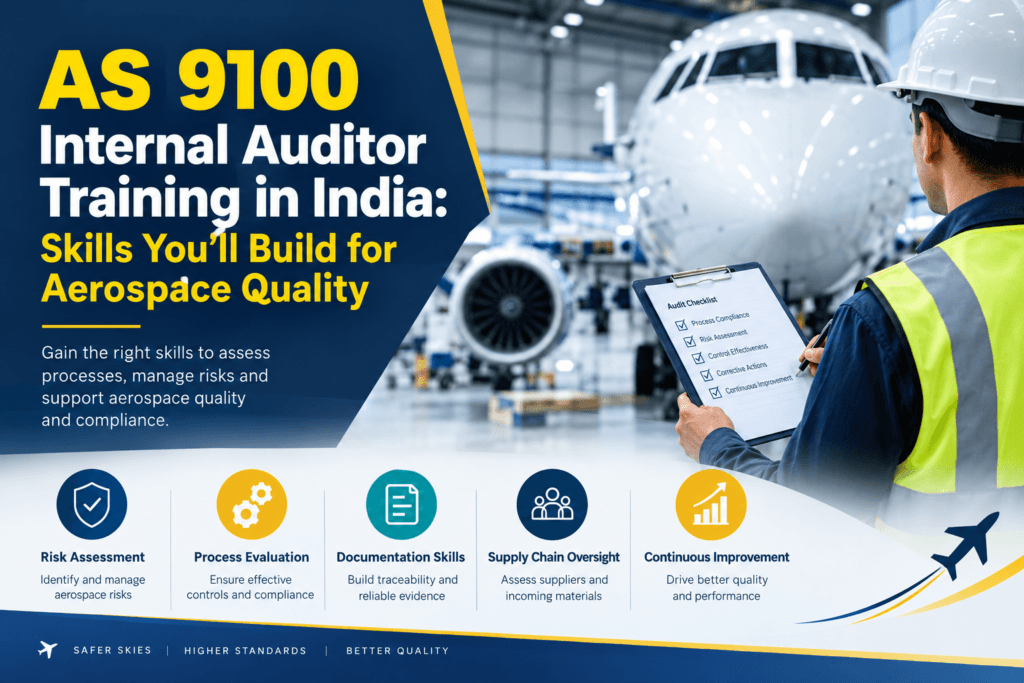
Understanding the skills developed through AS 9100 internal auditor training in India can help professionals see its practical value. Rather than focusing only on certification, it is useful to understand what participants can actually learn.
This training combines aerospace quality knowledge with practical auditing skills. As a result, professionals can become better prepared to evaluate processes, identify risks, and report findings.
This guide explains the key skills participants can develop through specialized aerospace internal auditor training.
Why Understanding These Skills Matters
Moving Beyond General Audit Knowledge
Aerospace auditing involves more than checking documents. Instead, auditors must understand processes, risks, controls, and technical requirements.
Therefore, learning about the specific skills developed during training gives professionals a clearer picture of the course.
Connecting Training with Workplace Responsibilities
These skills can also support daily quality activities. For example, professionals may use audit techniques when reviewing processes, investigating problems, or evaluating suppliers.
As a result, the training can provide value beyond formal internal audits.
Aerospace-Specific Risk Assessment Skills
Evaluating Safety-Critical Process Controls
Aerospace organizations must pay close attention to safety-critical processes. Therefore, auditors need to understand how these processes are controlled.
During training, participants learn how to evaluate whether important controls are properly implemented. They can also learn how to identify weaknesses that may affect product quality or safety.
Assessing Configuration Management Practices
Configuration management is another important area in aerospace quality. Auditors need to verify that products and processes match approved requirements.
Therefore, participants learn to review configuration controls. They also learn how to check whether changes are properly controlled and documented.
Evaluating Change Management Processes
Changes can affect product performance and compliance. For this reason, organizations need effective change management processes.
Training helps participants assess how changes are requested, reviewed, approved, and recorded. In addition, auditors learn to check whether employees follow established procedures.
Assessing Non-conformance Handling
Nonconforming products require careful attention in aerospace manufacturing. Therefore, auditors need to evaluate how organizations identify and control such issues.
Participants learn to review non-conformance records and corrective actions. They can also assess whether the organization prevents similar problems from happening again.
Traceability and Documentation Skills
Conducting Thorough Traceability Reviews
Traceability is especially important in the aerospace sector. Products often move through several processes and suppliers before reaching the final stage.
Therefore, auditors need strong documentation review skills. During training, participants learn how to verify whether records provide reliable evidence of conformity.
Evaluating First Article Inspection Processes
First Article Inspection is an important quality control activity. It helps organizations confirm that production processes can meet approved requirements.
As a result, internal auditors need to understand how FAI activities are planned, performed, and documented. Training helps participants evaluate these controls more effectively.
Supply Chain Evaluation Skills
Assessing Supplier Quality Management
Aerospace supply chains can involve several levels of suppliers. Therefore, supplier quality management requires careful evaluation.
Participants learn how to assess supplier controls and performance. They can also review how organizations monitor supplier-related risks.
Evaluating Incoming Material Verification
Incoming materials and components must meet specified requirements. For this reason, organizations need effective inspection and verification processes.
Training helps auditors evaluate receiving inspections, material records, and related controls. In addition, they learn how to identify gaps in incoming material verification.
Assessing Supplier Audit Programs
Supplier audits should provide useful information about supplier performance. However, some audit programs may focus too heavily on basic compliance.
Therefore, participants learn to assess whether supplier audits are effective. They can examine audit planning, findings, corrective actions, and follow-up activities.
Core Audit Methodology Skills
Planning Effective Aerospace Audits
Good audit planning helps teams focus on important risks. Therefore, participants learn how to develop structured audit plans.
They also learn how to consider processes, previous findings, risks, and applicable requirements. As a result, audit time can be used more effectively.
Conducting Purposeful Technical Interviews
Auditors need to communicate with people across different departments. For example, they may interview engineers, production employees, quality professionals, and managers.
Therefore, training helps participants develop better questioning techniques. They learn to ask open-ended questions and gather objective evidence.
Writing Clear Audit Findings
Audit findings must be accurate and easy to understand. For this reason, participants learn how to document evidence-based findings.
They also learn to connect findings with applicable requirements. In addition, clear writing helps organizations understand what needs attention.
Presenting Findings to Cross-Functional Teams
Audit results may involve several departments. Therefore, auditors must explain findings clearly to different audiences.
Participants develop communication skills that can help them present findings to engineering, quality, production, and management teams.
Completing AS 9100 internal auditor training in India can therefore help professionals develop both aerospace-specific knowledge and structured audit skills.
Analytical and Evaluative Skills
Distinguishing Critical and Minor Findings
Not every audit finding has the same level of importance. Therefore, auditors need sound judgment when evaluating evidence.
Training helps participants understand the significance of different findings. As a result, they can communicate issues according to their potential impact.
Evaluating Root Cause Analysis
Corrective action should address the real cause of a problem. However, organizations sometimes focus only on visible symptoms.
Therefore, auditors learn to evaluate root cause analysis more carefully. They can review whether corrective actions address the actual source of a nonconformity.
Communication Skills for Aerospace Auditors
Communicating With Technical Precision
Aerospace environments often involve complex technical information. Therefore, auditors need to communicate findings accurately.
Training helps participants explain issues in a clear and professional manner. In addition, precise communication can reduce misunderstandings during audits.
Building Credibility with Technical Teams
Auditors often work with experienced technical professionals. Therefore, credibility is important.
By developing technical knowledge and structured audit skills, participants can communicate more confidently with engineering and production teams.
How These Skills Apply Beyond Formal Audits
Supporting Quality Improvement
Audit skills can support broader quality improvement activities. For example, professionals can use risk assessment and root cause analysis when reviewing internal processes.
Therefore, the skills gained through training can contribute to continuous improvement initiatives.
Building Industry-Relevant Expertise
Aerospace organizations value professionals who understand quality requirements and audit practices. Consequently, specialized audit skills can support career development.
These capabilities can be useful even when a professional does not hold a formal internal auditor title.
Skills That Support Long-Term Career Growth
Building a Reputation for Technical Rigor
Consistent and accurate auditing can help professionals build credibility. Therefore, applying audit skills carefully can strengthen their professional reputation.
Over time, practical experience can make these skills more valuable.
Preparing for Advanced Aerospace Quality Roles
Internal auditing provides a strong foundation for broader quality responsibilities. For example, professionals may progress toward roles involving quality management, supplier quality, compliance, or auditing.
Therefore, AS 9100 internal auditor training can support continued professional development.
Contributing to a Strong Safety Culture
Quality and safety are closely connected in aerospace. For this reason, effective internal auditing can support an organization’s safety culture.
By identifying weaknesses early, auditors can help organizations improve processes and reduce potential risks.
Common Questions about Skill Development
How Quickly Do These Skills Develop?
The learning process varies between professionals. However, regular practice can make auditing techniques easier to apply.
Therefore, participants should use their knowledge in real workplace situations whenever possible.
Do These Skills Require Prior Aerospace Experience?
Prior aerospace experience can be helpful. However, professionals can build their understanding progressively through structured training and practical application.
Therefore, beginners can also benefit when the course provides a clear introduction to aerospace quality requirements.
Can These Skills Transfer to Other Manufacturing Sectors?
Yes. Many auditing skills can apply across different manufacturing environments.
For example, risk assessment, traceability, documentation review, root cause analysis, and supplier evaluation are useful in several industries.
However, aerospace auditing has its own specific requirements and expectations.
Is Refresher Training Useful?
Yes. Quality requirements, organizational processes, and industry practices can change over time.
Therefore, refresher learning can help professionals maintain their knowledge. In addition, regular audit experience helps strengthen practical skills.
A Final Note on This Specialized Investment
Recognizing the Long-Term Value of Specialization
Specialized aerospace knowledge can provide long-term professional value. As professionals gain experience, they can combine technical understanding with effective auditing practices.
Therefore, the value of training can grow through continued workplace application.
Building Confidence through Practice
Training provides a foundation, but practical experience strengthens that foundation. Consequently, professionals should continue applying audit methods after completing their course.
With regular practice, participants can become more confident when planning audits, collecting evidence, and reporting findings.
Bringing It All Together
Understanding the skills developed through AS 9100 internal auditor training in India makes the value of specialized aerospace training clearer.
Participants can develop skills in risk assessment, traceability, supplier evaluation, audit planning, evidence collection, and finding documentation. In addition, they can strengthen their analytical and communication abilities.
Most importantly, these skills can support effective internal auditing and broader quality improvement. Therefore, professionals who continue applying and developing these capabilities can build valuable expertise within the aerospace and defense sector.